
BestInterest for Coparents
BestInterestParenting
4.416.00 Reviews
- Version
- 3.0.3
- Installs
- 10.00K
- Age Rating
- Everyone
Screenshots

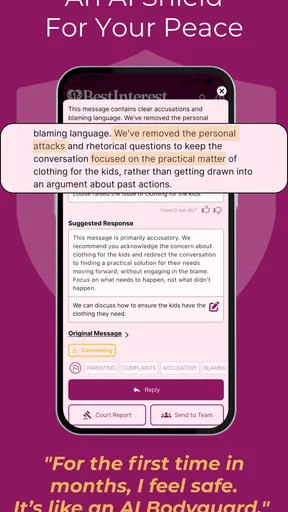
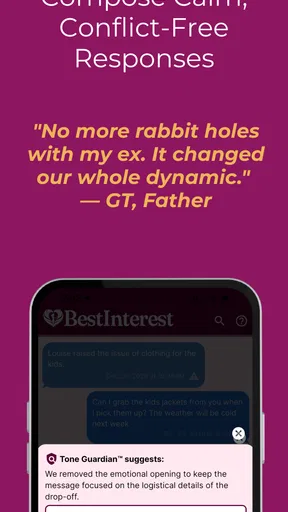
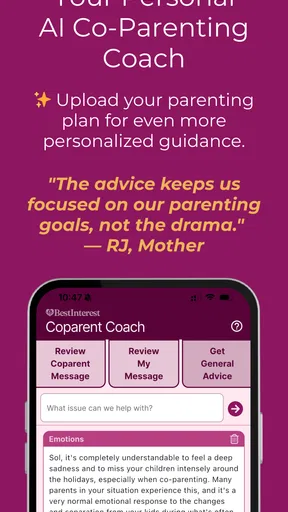
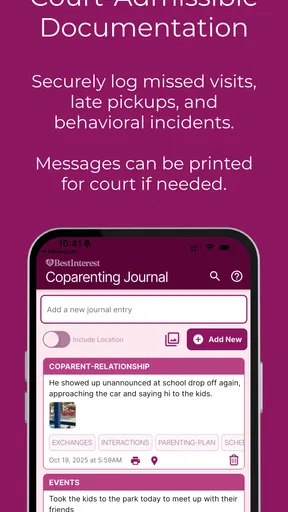
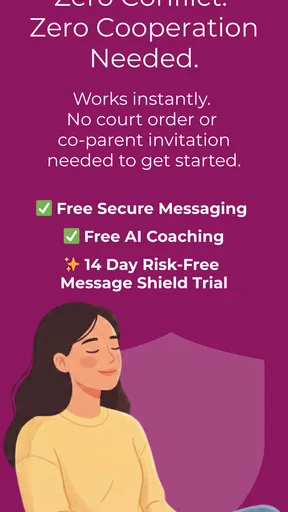

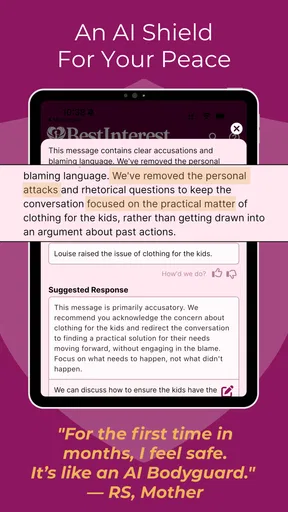
Our Review of BestInterest for Coparents
 Analysis by Appyee
Co-parenting becomes difficult when every message feels loaded, small decisions turn into arguments, and practical details get mixed with old relationship problems. BestInterest for Coparents takes a focused approach to that situation. It is a parenting app from BestInterest built around calmer communication, shared parenting coordination, and AI-assisted support. After spending time with it, I see the appeal: it tries to make co-parenting less reactive without pretending that a piece of software can repair a damaged relationship.
The app is free to install, which makes it easy to test without committing money at the start. It is listed for Everyone and runs on Android devices using version 7.0 or later. The current release is 3.0.3, and the app has passed the early discovery stage with over ten thousand installs. Its average rating sits at 4.4 from just over a hundred ratings, so the overall response is encouraging, although the user base is still modest enough that I would treat that score as a useful signal rather than a final verdict.
How BestInterest fits into real co-parenting
The most useful way to understand BestInterest is not as a general family calendar or a simple messaging tool. Its purpose is more specific: helping two parents communicate about children with less conflict and with a clearer record of what was said. That focus matters because ordinary texting apps are designed for speed and informality, not for emotionally sensitive conversations that may need to be revisited later.
In a typical exchange, one parent may need to ask about a school pickup, a medical appointment, a schedule change, or an expense. The factual question is often simple, but the wording can carry frustration from earlier disagreements. An AI-powered co-parenting tool can be useful at that point because it encourages a pause between the emotional reaction and the message that finally gets sent. I found that idea more valuable than the promise of automation itself.
The strongest benefit is the pause it creates before a difficult message becomes a bigger problem. That is especially relevant for parents who already know they communicate poorly when tired, rushed, or angry. Instead of sending the first draft, I would use the app as a checkpoint: state the practical issue, remove accusations, identify the decision needed, and keep the child’s routine at the center.
AI assistance is most useful as a filter, not a replacement for judgment
It is tempting to think of AI as something that will solve conflict automatically. I would not approach BestInterest with that expectation. A tool can help make a message calmer or more focused, but it cannot know every family history, legal agreement, safety concern, or emotional trigger. The parent still has to check the result before relying on it.
That human review is not a minor detail. A polite message can still be inaccurate, too vague, or inappropriate for the situation. If a child has a time-sensitive health issue, I would contact the relevant person directly rather than waiting for an app workflow. If there is a serious safety concern, coercive control, or a court order with specific communication rules, professional advice should come before trusting an AI-assisted exchange.
For ordinary co-parenting friction, though, the approach makes sense. The app can help separate “what happened” from “how I feel about what happened.” That distinction is easy to describe and surprisingly hard to maintain in a normal chat thread. BestInterest is aimed at that exact gap.
A realistic weekday example
Imagine that a child has a school activity on a day that normally belongs to the other parent. One parent notices the schedule late in the afternoon and wants to ask for a change. In a normal messaging app, the first draft might say, “You never check the school messages, so I guess I have to fix this again.” That sentence may express genuine frustration, but it also invites a defensive reply and shifts attention away from the child’s activity.
Using BestInterest, I would turn the request into something more practical: the event time, the transportation problem, the proposed adjustment, and a request for confirmation. The important insight is not that AI creates perfect wording. It is that the workflow can help the parent recognize which parts of the draft are useful and which parts are old resentment attached to a new scheduling issue.
That makes the app particularly suitable for recurring, low-to-medium intensity disagreements. It is less likely to help when both parents are already in an active crisis and need immediate human intervention. The distinction is important: BestInterest can support better communication, but it is not a mediator, therapist, lawyer, emergency service, or substitute for a formal parenting agreement.
Why a dedicated co-parenting space can beat ordinary texting
Text messages and email are familiar, fast, and available to almost everyone. They also encourage fragmented conversations. A schedule change may be discussed in one thread, an expense in another, and a school update somewhere else. Weeks later, finding the actual agreement can become harder than making it in the first place.
A dedicated co-parenting app has a different advantage: it gives the conversation a purpose. Even when the underlying tools seem familiar, the context changes how parents use them. The question is no longer simply “What do I want to say?” but “What information does the other parent need, and what decision needs to be recorded?” That shift is one of the practical strengths I associate with BestInterest.
It may not replace every tool a family already uses. A shared calendar can remain better for visualizing a complicated custody schedule, while email may be preferable for sending a long document or communicating with a school. BestInterest makes more sense as the calm communication layer between those tools, especially when messages themselves are the main source of conflict.
Cost, value, and the limits of the free starting point
BestInterest is free to download, so the initial value is straightforward: parents can explore its approach before paying. That matters in this category because co-parenting tools are personal. A feature that looks helpful in a description may feel awkward once it is used during a real disagreement. Free access lowers the risk of discovering that the communication style does not suit both parents.
The app also includes in-app purchases ranging from $9.99 to $299.99 per item. That is a wide span, so I would not assume that every useful capability is included at no cost or that the highest-priced option is necessary. The sensible approach is to begin with the free experience, understand what it actually handles, and only then decide whether a paid option delivers enough additional value for your family.
This pricing structure creates two different questions. The first is whether the free version is useful enough to improve everyday communication. The second is whether a paid purchase saves enough time, stress, or repeated conflict to justify the expense. Those answers will vary considerably between a parent who needs occasional wording help and a family managing frequent schedule disputes.
I would be especially careful before buying the most expensive item. A high purchase price can be reasonable for a substantial long-term service, but it should not be treated as proof that the app is more effective. The value has to come from the actual experience: whether both parents use it, whether messages become clearer, and whether important decisions are easier to revisit.
Where the app delivers practical value
The app’s value is strongest when communication is the bottleneck. If both parents already cooperate well, share information reliably, and rarely misunderstand one another, a basic calendar and messaging app may be enough. BestInterest becomes more compelling when the parents agree that communication needs structure but do not want every exchange to become formal or hostile.
One non-obvious use is drafting a message before a predictable trigger occurs. If school pickups, holiday arrangements, or reimbursement requests regularly lead to arguments, I would prepare the factual details first and use the app before emotions rise. This turns it from a rescue tool into a habit-building tool. The goal is not to make every message sound artificial; it is to make the important information harder to bury under blame.
Another useful workflow is to write down the decision you need before writing the explanation. For example, decide whether you are asking for a swap, requesting confirmation, sharing information, or documenting an expense. Then keep the message centered on that purpose. This is a small discipline, but it prevents a common co-parenting problem: sending a long message that contains several complaints and no clear request.
A third insight is that calm wording does not mean agreeing to everything. Parents sometimes confuse conflict-free communication with being passive. BestInterest is more useful when it helps a parent state a firm boundary in neutral language. “I can do pickup at this time, but I cannot extend it beyond that time” is clearer than either an angry refusal or an overly apologetic explanation. The app’s calm approach should support precision, not erase legitimate limits.
Tradeoffs that deserve attention
The first tradeoff is convenience versus review. AI can make drafting feel easier, but the parent must still read carefully. A suggested message may sound balanced while leaving out a necessary date, responsibility, or condition. I would never send an AI-assisted message without checking names, times, commitments, and the exact request.
The second is neutrality versus warmth. A message that is too polished can feel cold, particularly when a child is sick, anxious, or celebrating something important. Not every exchange needs formal-sounding language. I would use the app’s structure for disagreements and logistics, then add a natural human sentence when the situation calls for empathy.
The third tradeoff concerns adoption by both parents. One parent can improve their own messages, but a shared co-parenting system works best when both people participate. If the other parent refuses to use the app, the benefit may be limited to private drafting and self-editing. That can still help, but it is not the same as having a mutually accepted communication channel.
There is also a practical learning curve. Parents who are comfortable with texting may initially wonder why they should change a habit that is fast and familiar. The answer is not that every message needs extra steps. The answer is that certain conversations are expensive when handled casually. I would reserve BestInterest for those high-friction moments rather than forcing every routine update through a heavier process.
Privacy, records, and responsible use
Because co-parenting messages can involve children, health information, school details, and financial responsibilities, I would use deliberate judgment about what I write. Avoid adding unnecessary personal information when a simpler statement will do. Keep the focus on the child and the decision at hand. If a message may matter later, make it factual and understandable to someone who was not present for the argument.
The idea of court-admissible communication may sound reassuring, but I would not interpret it as a guarantee that every message will be accepted or given a particular weight in a legal setting. Courts and legal professionals decide what matters in context. If documentation is important, preserve relevant records carefully and follow advice from a qualified professional. The app can encourage clearer communication; it cannot determine legal outcomes.
This is also why I would avoid using the platform to provoke, test, or trap the other parent. A calm record is valuable only when it reflects genuine communication. Writing messages for an imagined audience rather than for the practical needs of the child can create a different kind of conflict. The best results come from treating the app as a tool for clarity, not as a weapon.
Who will get the most from it?
I think BestInterest is a good fit for separated or divorced parents who are basically willing to cooperate but repeatedly get stuck in tone, timing, and misunderstandings. It is also useful for parents who want help turning emotional drafts into specific requests. Families with frequent schedule changes may appreciate having a dedicated place to slow down before responding.
It may also suit a parent who is currently using ordinary texts as a record but dislikes how chaotic those conversations become. The app’s parenting focus can encourage more disciplined messages without requiring the parent to become an expert in conflict resolution. That is a meaningful benefit for someone who knows what they want to say but struggles to say it without reopening an old dispute.
I would recommend skipping it, or at least treating it as secondary, when the situation involves immediate danger, threats, severe harassment, or a need for professional mediation. In those circumstances, an AI co-parenting assistant is not the right first response. It is also a weaker choice for parents who already have a smooth system and do not want another app to maintain. A shared calendar, email account, or established family-management service may be simpler for them.
Parents who expect the app to make the other person reasonable will probably be disappointed. BestInterest can improve one parent’s process, but it cannot force cooperation. Likewise, someone looking for a complete custody-management system should examine the actual workflow carefully before paying. The app’s central promise is communication support, not a replacement for every parenting, legal, or scheduling tool.
My buy-or-skip verdict
I would try BestInterest before spending money because the free entry point makes experimentation sensible. Use it during a few real but manageable situations: a schedule adjustment, a school update, or a disagreement about responsibilities. Pay attention to whether the messages become more specific and whether you feel less tempted to send an angry first draft. Those are better indicators of value than the app’s feature list.
The paid options may be worthwhile for families that use the app consistently and can identify a clear improvement in communication. I would not buy simply because a premium item sounds more complete, and I would not assume the most expensive purchase is appropriate. The right decision depends on whether the additional cost solves a recurring problem that free tools do not solve for your family.
My overall view is positive but measured. BestInterest for Coparents has a clear purpose, a useful AI-assisted angle, and a sensible place between casual texting and formal professional support. Its real strength is helping parents turn emotionally charged situations into concrete, child-focused requests. Its real limitation is that it still depends on human judgment, honest participation, and the seriousness of the situation.
For a parent who wants calmer exchanges and is willing to review every message before sending it, I think it is worth trying. For urgent safety issues, entrenched legal disputes, or families already satisfied with a simple shared calendar, I would choose a more appropriate solution. In the situations it is designed for, BestInterest is most valuable not when it speaks for you, but when it helps you choose your words more carefully.
Verdict
Strengths of BestInterest for Coparents
- Keeps parenting discussions focused on the child’s needs
- Provides a shared space for schedules, tasks, and important updates
- Can reduce misunderstandings by keeping communication documented
- Useful for coordinating responsibilities across separate households
- Encourages more structured and consistent co-parenting routines
Limitations of BestInterest for Coparents
- Both parents may need to use the app for its full benefits
- Some features may require time to set up and learn
- Sensitive family information is stored within a third-party service
- Notifications can become overwhelming during busy parenting periods
- May not replace legal advice or formal custody documentation
Similar Picks in This Category
View All
Family Space
Motorola Mobility LLC.3.9

شرطة الأطفال - مكالمة وهمية
Oub Apps4.1

Findmykids: Parental Control
LETEM LTD4.6

Pregnancy + | Tracker App
Philips Electronics UK Limited4.8

Policía de niños - para padres
Kids police4.7

Pregnancy App
Amila4.9
Frequently Asked Questions
What is BestInterest for Coparents, and who is it designed for?
BestInterest for Coparents is a co-parenting communication and organization app designed for separated or divorced parents who share responsibility for raising a child. It can help keep conversations, schedules, expenses, and parenting details in one organized place. The app is most useful when both parents want a clearer record of arrangements and more structured communication, although its available features may depend on the current plan and region.
What features can parents use in BestInterest for Coparents?
The app is intended to support practical co-parenting tasks such as communicating about children, coordinating schedules, recording important information, and managing shared responsibilities. Depending on the version you install, you may find tools for calendars, messages, expense tracking, documents, or parenting records. Before downloading, check the official listing carefully because features, limits, and subscription options can change with updates.
Does BestInterest for Coparents replace a parenting agreement or legal advice?
No. BestInterest for Coparents should be treated as an organizational and communication tool, not as a replacement for a court-approved parenting plan, mediation, or advice from a qualified family-law professional. Records stored in an app may be helpful for personal organization, but their legal value can vary by jurisdiction and circumstance. Parents should confirm important legal requirements with an appropriate professional.
Is BestInterest for Coparents suitable when communication between parents is difficult?
It may be helpful for parents who need more structured, focused communication, especially when discussions often become confusing or important details are lost in text messages. Keeping parenting-related information together can make responsibilities easier to review. However, the app cannot resolve conflict by itself. If there are safety concerns, harassment, coercive control, or urgent legal issues, seek professional or emergency support rather than relying only on the application.
Is BestInterest for Coparents free to download, and what should I check before installing it?
The application may be available to download without an upfront charge, but some features can require a subscription, purchase, account registration, or participation from both parents. Review the current Google Play or App Store listing for pricing, trial terms, supported devices, privacy information, and cancellation rules. Also check whether the app works in your country and whether both co-parents need separate accounts to use its main features.
